
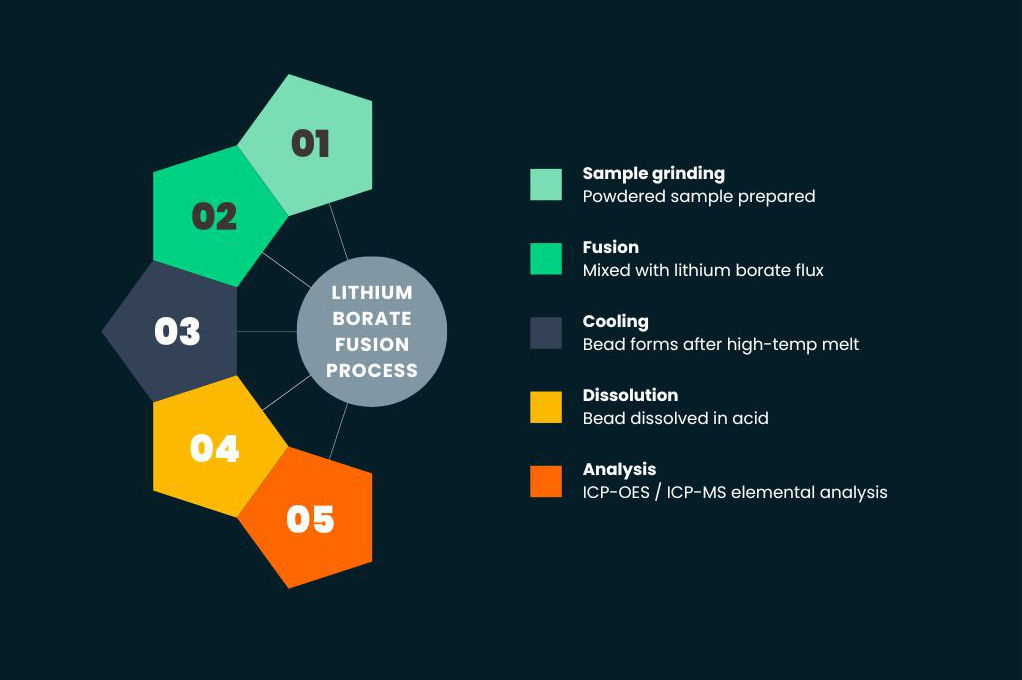
Lithium borate fusion is a high-temperature sample preparation technique used to dissolve geological materials into a homogeneous solution, suitable for analysis by either ICP-OES (inductively coupled plasma optical emission spectrometry) or ICP-MS (mass spectrometry). It is widely used when conventional acid digestion is not sufficient to break down the sample matrix, especially for geological rock and process samples with complex silicate structures.
In this method, a powdered sample is mixed with lithium borate flux and heated in a graphite crucible until fully fused. The fused material is then dissolved in acid and analyzed using:
This workflow results in near-total recovery of elements and enables consistent and high-quality geochemical data.
Acid digestion methods, such as aqua regia and 4-acid digestion, are widely used but have limitations. They may leave behind refractory minerals, leading to incomplete elemental recovery. Lithium borate fusion, on the other hand, enables total digestion of the sample, which is particularly important when analyzing:
This difference is crucial when data accuracy directly affects exploration decisions and geological interpretations.
| Acid Digestion | Lithium Borate Fusion | |
| Matrix dissolution | Partial | Total |
| Silicate compatibility | Limited | Excellent |
| REE & HFSE recovery | Incomplete | Reliable |
| Major oxide coverage | Poor | Full range |
| Reproducibility in hard matrices | Variable | High |
Sample preparation is a critical step in any mineral exploration workflow. For rock and process samples with complex or silicate-rich matrices, lithium borate fusion offers key advantages:
These strengths make fusion an ideal choice for drill core programs, mineral processing tests and baseline studies where analytical precision is essential.
Not every project requires fusion, but when you need total digestion and reliable detection of a broad range of elements, this method offers clear benefits.
Lithium borate fusion is recommended when
CRS Laboratories offers two fusion-based methods, performed in our accredited* laboratory in Kempele, Finland:
Both methods include full quality control: certified reference materials, blank samples, and duplicates. Our team is available to help you select the most suitable method for your sample type and exploration goals.
The following tables show selected measurement ranges for common analytes using CRS’s lithium borate fusion methods.
| LBF-ICP18 (major elements) | ||
| Element | Lower limit | Upper limit |
| Al₂O₃ | 0.1% | 100% |
| Fe₂O₃ | 0.01% | 70% |
| SiO₂ | 0.1% | 60% |
| CaO | 0.02% | 70% |
| K₂O | 0.1% | 45% |
| LBF-MS18 (trace and rare earth elements) | ||
| Element | Lower limit | Upper limit |
| La, Ce, Nb | 1 ppm | 5 % |
| U | 1 ppm | 0.1% |
| Zr | 5 ppm | 2.5% |
| Nd | 1 ppm | 2.5% |
Lithium borate fusion is now available as part of CRS’s analytical service portfolio. Both methods — LBF-ICP18 and LBF-MS18 — are designed to support high-quality geochemical investigations and help exploration teams make informed decisions with confidence.
You can find the full list of available methods, including lithium borate fusion with ICP-OES and ICP-MS finishes, in our Schedule of Services.